

Office Sector Reclaims Top Spot; Investment Set to Climb Up to 10 Percent
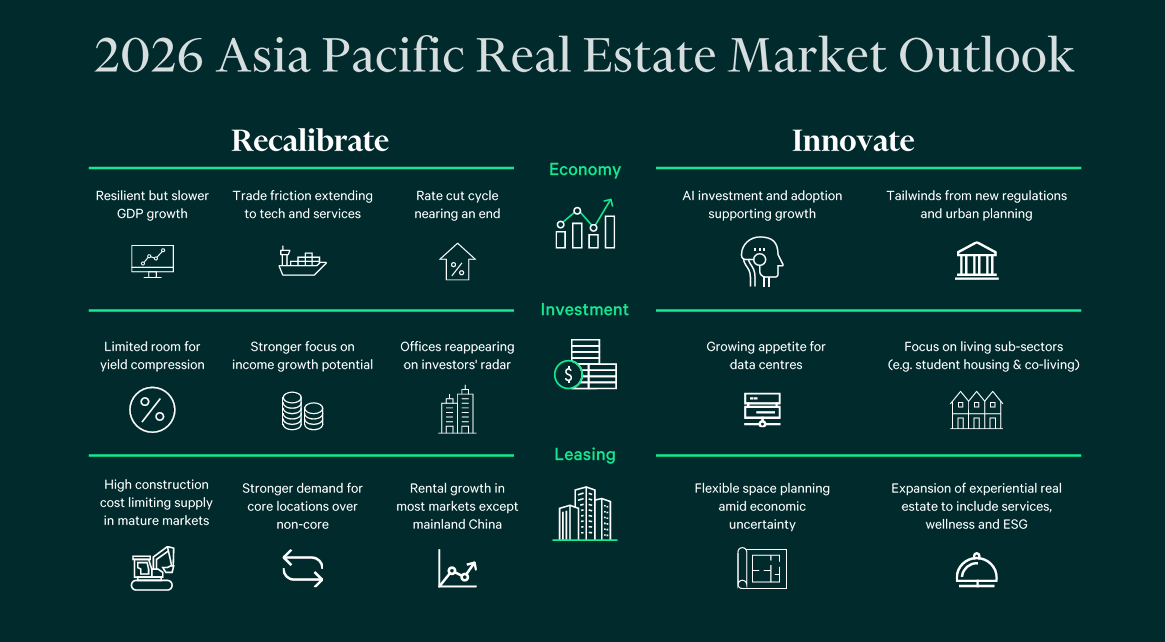
Asia-Pacific commercial real estate is entering 2026 with renewed momentum as investors and occupiers reposition portfolios around income growth, even as the region’s broader economic expansion cools.
A new outlook from CBRE projects investment volumes across the region will rise between 5% and 10% this year, extending a rebound that took hold in 2025. Full-year transaction activity reached $157 billion last year, up 22% from 2024, signaling that capital is steadily returning after a prolonged period of caution tied to higher interest rates and macro uncertainty.
The firm expects net buying intentions — a gauge of investor appetite — to climb to 17% in 2026, compared with 13% in 2025 and just 5% in 2024. While yield compression is likely to remain limited, investors are increasingly underwriting rental growth and durable income streams as the primary sources of return.
“The market is shifting into a phase where income resilience and active asset management matter more than cap-rate expansion,” said Ada Choi, CBRE’s Head of Research for Asia Pacific. Companies, she added, are tightening space strategies while prioritizing high-quality assets in core locations, reinforcing a broader “flight to quality” theme across sectors.
Offices Regain Favor
In a notable shift, office properties have emerged as the preferred asset class among regional investors for the first time since 2020. Improving leasing fundamentals and constrained new supply in prime business districts are underpinning the renewed interest.
Leasing demand is expected to strengthen further in 2026 as corporations sharpen attendance policies and concentrate operations in top-tier buildings. Expansionary demand is being driven by technology firms — particularly software companies benefiting from artificial intelligence adoption — as well as wealth management and professional services groups.
Grade A office completions across the region are forecast to peak at 61.3 million square feet this year, with more than three-quarters of new supply concentrated in India and mainland China. In developed markets, however, high construction costs are limiting new projects, supporting rental growth in established CBDs including Tokyo and Singapore, along with major Australian downtown cores.
Cross-Border Capital Targets Gateway Cities
Global capital continues to gravitate toward the region’s most liquid markets. Tokyo remains the leading destination for cross-border investment, followed by Sydney. Singapore and Seoul are running neck-and-neck, while Hong Kong has re-entered the top tier of preferred locations after a period of subdued activity.
Data centers are also climbing investor rankings, reflecting sustained demand from cloud computing, AI infrastructure and digital services. The sector now stands among the region’s top four preferred asset classes.
Logistics Growth Moderates, Pipeline Tightens
The logistics sector, a pandemic-era outperformer, is expected to deliver continued rental growth across most Asia-Pacific markets, though at a slower pace. Third-party logistics providers and e-commerce operators remain primary demand engines, favoring large-scale, automation-ready facilities.
Development pipelines are set to thin from 2027 onward as elevated land and construction costs weigh on feasibility. That pullback in new supply could help stabilize occupancy and rent trajectories in core distribution hubs.
Retail Repositions Around Experience
Retail leasing is projected to exceed 2025 levels, supported by improving consumer sales and greater clarity on trade policy across key economies. Tight vacancy in prime districts and limited forward supply are intensifying competition for well-located space.
Landlords continue to recalibrate tenant mixes toward dining, wellness, and service-oriented concepts, accelerating the shift toward experiential formats designed to draw foot traffic and extend dwell time.
Hotel Sector Normalizes
In hospitality, tourism flows are approaching pre-pandemic levels, but growth is expected to moderate as the recovery cycle matures. Event-driven travel will continue to buoy performance in major gateway cities, though revenue per available room (RevPAR) gains are likely to ease as average daily rates normalize.
Across asset classes, 2026 is shaping up as a year defined less by rapid repricing and more by disciplined capital deployment, selective leasing expansion and a renewed emphasis on cash-flow durability. For investors navigating slower economic growth, the region’s real estate markets are increasingly being viewed as a play on income stability rather than speculative upside.
Sign Up Free | The WPJ Weekly Newsletter
Relevant real estate news.
Actionable market intelligence.
Right to your inbox every week.
Real Estate Listings Showcase
Please visit:
Our Sponsor
