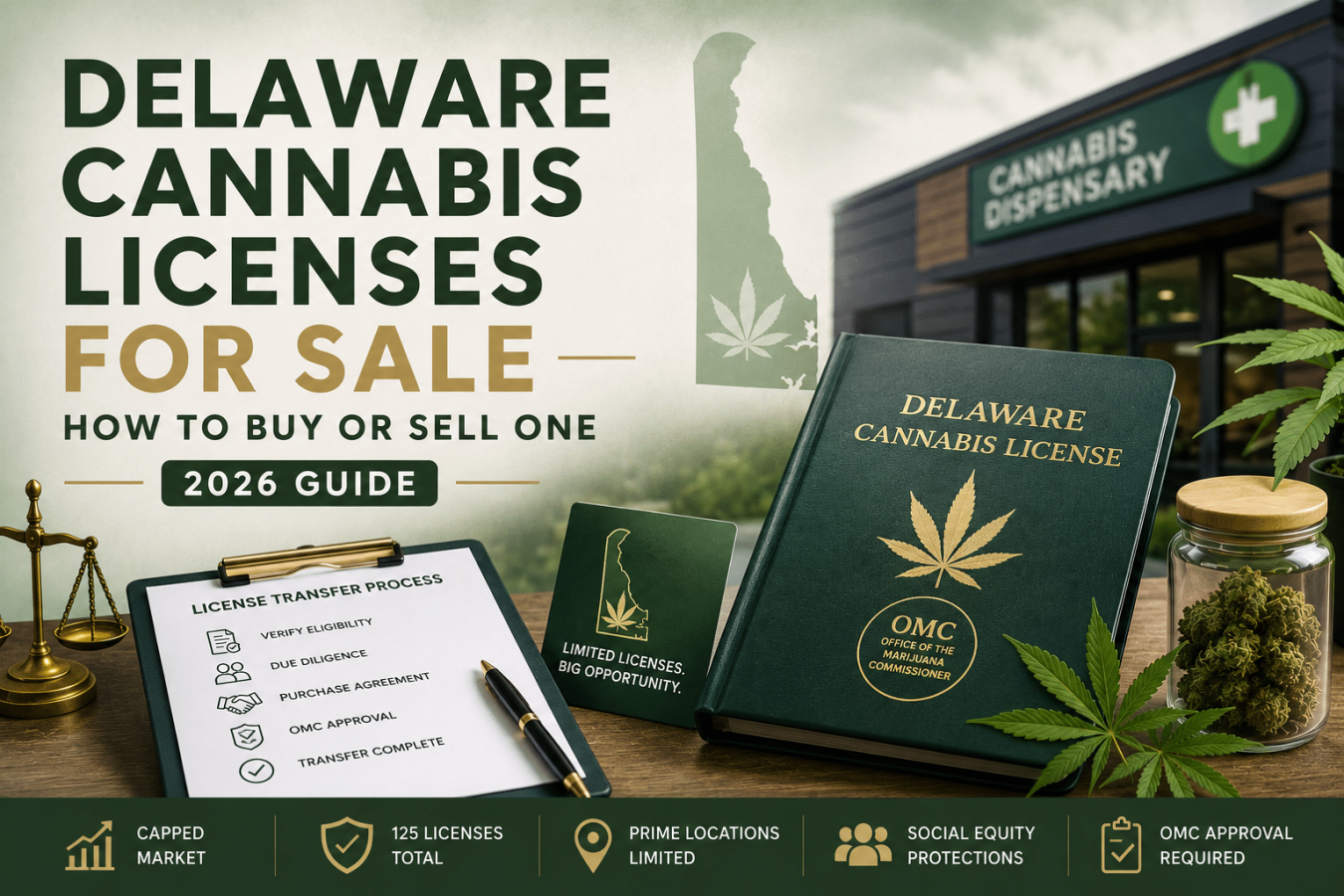
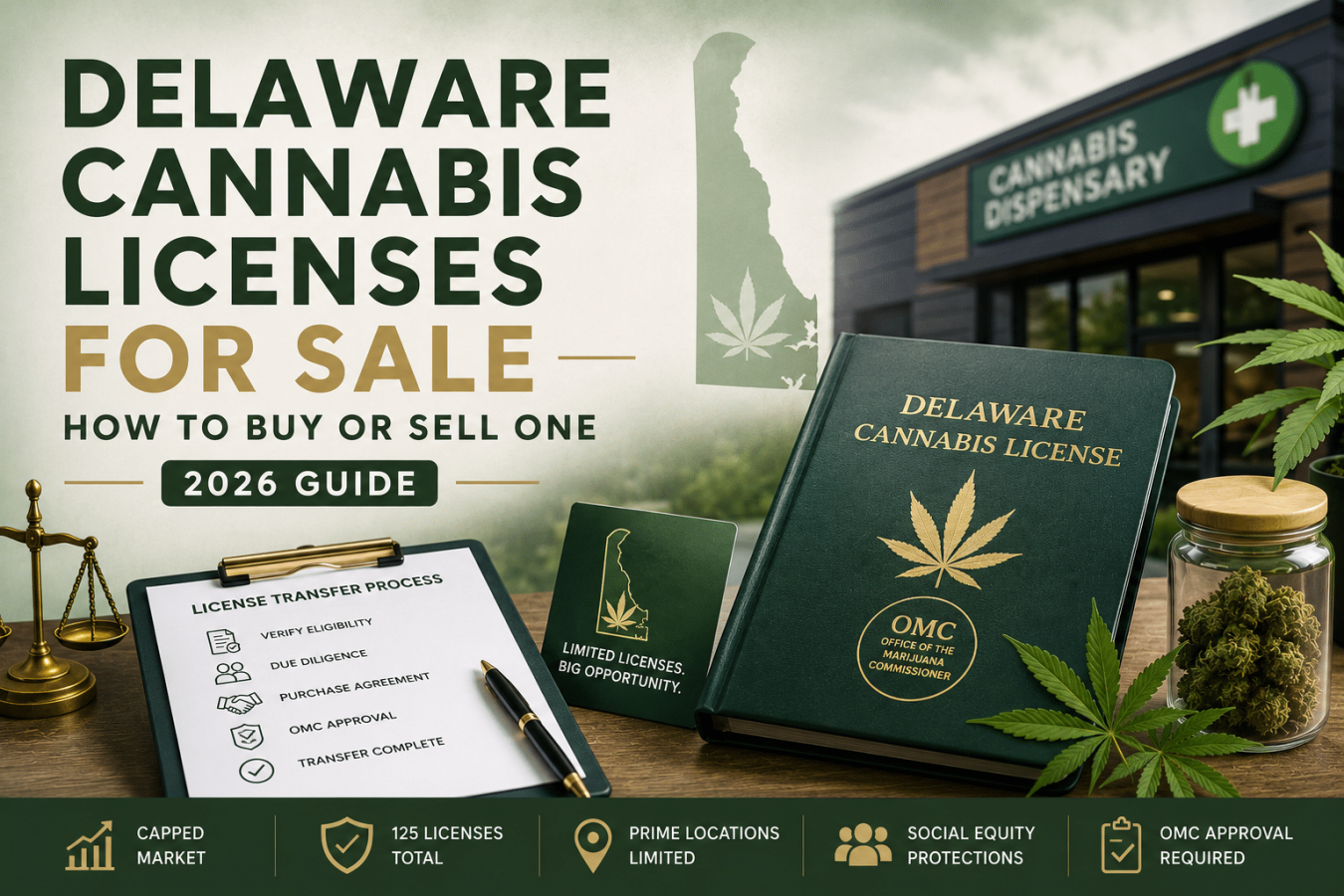
Delaware is the newest adult-use cannabis market on the East Coast — and one of the most tightly capped. Recreational sales began on August 1, 2025, opening a brand-new market of legal-age consumers, plus out-of-state demand from Maryland, Pennsylvania, and New Jersey border traffic. But here is what matters if you searched for a Delaware cannabis license for sale: the state issued a fixed pool of licenses through a one-time lottery, and that application window is closed. With no open application process, the way into Delaware’s market today is the same as in other capped states — acquiring a license or licensed business from an existing holder, through a transfer approved by the OMC.
That scarcity is exactly why Delaware license listings are among the most-watched inventory on our marketplace right now. This guide covers how Delaware’s license structure works, what the transfer rules allow (and prohibit), what buyers should verify before making an offer, and how sellers can position a Delaware license for a strong exit.
Delaware’s License Structure: Small State, Hard Caps
Delaware legalized adult-use cannabis in April 2023 (House Bills 1 and 2), becoming the first state to legalize through the legislature rather than a ballot measure. The Office of the Marijuana Commissioner, under the Department of Safety and Homeland Security, regulates the market.
The OMC awarded its adult-use business licenses through a lottery process that drew heavy oversubscription: 125 licenses across retail, cultivation, product manufacturing, and testing, with at least 47 reserved for social equity applicants. Alongside the lottery winners, Delaware’s existing medical compassion centers received conversion licenses that allowed them to open the first adult-use storefronts on day one.
For buyers and sellers, three structural facts drive the market:
- The caps are real. A fixed license pool in a small state means each license is a scarce, defensible market position — closer to a New Jersey or Illinois dynamic than to open-license states like Oklahoma.
- Retail is the scarcest tier. Only a small share of the 125 licenses are retail stores, and retail is where border-traffic revenue concentrates.
- Location approval is its own battle. Delaware municipalities can opt out or restrict cannabis businesses, and siting rules differ across New Castle, Kent, and Sussex counties — which is why buyers search specifically for licenses tied to approved locations (and why a license with local approval in hand commands a premium).
Can Delaware Licenses Be Sold? Yes — With OMC Approval and Restrictions
Delaware licenses are transferable, but every change of ownership or control runs through the OMC. The Commissioner’s office maintains formal processes for license transfers — including a separate track for transfers without compensation (entity restructuring, operation of law, or death of a licensee) — and transfers involving a sale require full disclosure filings and criminal background checks on the incoming owners before approval.
The single most important restriction to understand: social equity licenses carry a multi-year transfer hold. Under the OMC’s rules, social equity license winners are prohibited from transferring their permits for three years. Because at least 47 of Delaware’s 125 licenses are social equity licenses, a meaningful share of the state’s license pool is time-locked — which further tightens near-term supply of transferable licenses and affects both pricing and deal structuring. If you are evaluating a listed license, confirming its license class and any transfer restrictions is step one of due diligence, and structuring around a restricted license without OMC blessing is a fast way to lose both the deal and the license.
Delaware’s rules are also still moving: the OMC proposed amendments to its regulations as recently as spring 2026, covering licensing standards and operational requirements. Any purchase agreement should be drafted with regulatory change in mind — another reason cannabis-experienced legal counsel belongs in the deal before the letter of intent, not after.
What a Delaware License Costs to Hold
License fees in Delaware are modest relative to the asset’s scarcity value. As one benchmark set in statute, a retail marijuana store licensee pays the Commissioner $10,000 biennially, and retail renewal requires documentation of a labor peace agreement with employees’ representatives — a Delaware-specific requirement that out-of-state buyers frequently miss in diligence. Budget separately for the real costs of operating: compliant real estate, seed-to-sale tracking, testing, security, staffing, and the 15% retail tax environment your margins live in.
Acquisition pricing is a different question entirely — a scarce license in a capped East Coast market is valued on its market position, location approvals, and buildout status, not its renewal fee. Our guide to cannabis business valuation methods covers how buyers actually price license-driven acquisitions, and current asking prices are visible on live cannabis license listings.
Buying a Delaware License: The Due Diligence Checklist
- Confirm the license class and transfer eligibility. Standard or social equity? If social equity, where does it sit in the three-year hold? Retail, cultivation, manufacturing, or testing tier?
- Verify status with the OMC. Active and in good standing, conditional, or subject to operational deadlines? A license that must be operational by a looming deadline changes your timeline and price.
- Check the location stack. Municipal approval, county zoning, and setbacks — especially in Sussex County, where local restrictions are common. A license with an approved, compliant site (or better, real estate included) is a different asset than a license alone. Compare Delaware cannabis businesses and properties for sale to see how location-ready listings are packaged.
- Model the market honestly. Delaware is small; the bet is caps plus border demand, not population. Retail near the Maryland and Pennsylvania lines prices differently than interior locations.
- Structure for OMC approval. Ownership disclosures, background checks, and Commissioner sign-off are conditions of closing — sequence the purchase agreement accordingly, with escrow tied to regulatory approval. Our state-by-state license transfer guide explains how these closings are typically sequenced.
- Line up capital early. Traditional bank financing remains difficult for plant-touching acquisitions; explore cannabis financing options and seller-financed structures common in license deals.
Selling a Delaware License: Positioning for a Premium
If you hold a Delaware license — particularly retail, or any license with municipal approval secured — you are holding one of the scarcer cannabis assets on the East Coast. Sellers get the strongest outcomes by packaging the full story: license class and standing, location approvals and lease or real estate, buildout progress, and a clean compliance history. Listings that document these command more qualified interest than a bare license number. When you are ready, our guide to buying and selling cannabis businesses walks through preparing for diligence, and you can list a Delaware license or business on 420 Property to reach buyers searching this market daily.
Frequently Asked Questions
Can I still apply for a new Delaware cannabis license?
Not currently. Delaware awarded its adult-use licenses through a lottery, and that application window has closed. Unless the state opens a future round, entering the market means acquiring an existing license or licensed business through an OMC-approved transfer.
Are Delaware social equity licenses transferable?
Not freely. Under OMC rules, social equity license winners face a three-year prohibition on transferring their permits. Confirm the license class and its restriction window before negotiating — and confirm current rules with the OMC, as regulations continue to be amended.
How much is a Delaware cannabis license worth?
There is no fixed price — value depends on license tier (retail scarcest), transfer eligibility, location approvals, buildout status, and whether real estate is included. Review current license listings for live asking prices and our valuation guide for how buyers price them.
What taxes apply to Delaware cannabis retail?
Delaware applies a 15% tax on retail cannabis purchases — a key input when modeling margins for a retail acquisition near the Maryland and Pennsylvania borders.
Which Delaware counties are best for a cannabis business?
It depends on local approvals more than county lines: municipalities can opt out or restrict cannabis businesses, and siting rules differ across New Castle, Kent, and Sussex counties. A license paired with an approved location — see Wilmington cannabis businesses and other Delaware listings — removes the largest siting risk.
This guide is for informational purposes only and is not legal, tax, or investment advice. Delaware’s adult-use rules are actively evolving — verify current requirements with the Delaware Office of the Marijuana Commissioner (OMC) and consult a qualified cannabis attorney before any transaction.
Please visit:
Our Sponsor
