

Hong Kong’s stock market continues to serve as an early signal for movements in the city’s residential property sector, with equity gains typically preceding changes in home prices by just over two months, according to a new analysis from Jones Lang LaSalle.
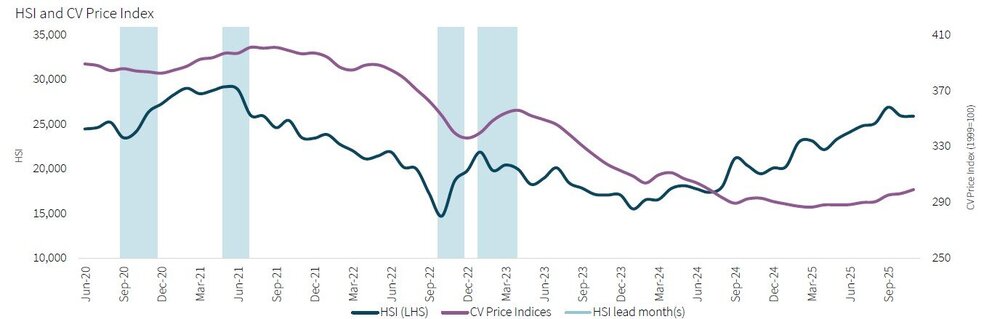
The Hang Seng Index leads residential capital values by an average of 2.2 months, reflecting the property market’s lower liquidity and the time lag associated with transaction registration, JLL said in its latest Hong Kong Residential Sales Market Dynamics report released this week. The findings highlight the close relationship between equity performance and housing prices in one of the world’s most asset-sensitive economies.
Since mid-2020, residential capital values and the Hang Seng Index have largely moved in tandem, the report shows. That relationship weakened temporarily in mid-2024, when stocks extended a rebound while home prices failed to follow. Instead of rising alongside equities, residential values posted a much shallower decline before stabilizing and beginning a modest recovery in August 2025.
The divergence underscores differences in volatility and adjustment speed between the two asset classes, though their overall directional alignment has remained intact, JLL said.

Norry Lee
“Reflecting the strong performance of the equity market, Hong Kong’s residential sector is expected to see near-term support,” said Norry Lee, senior director of project strategy and consultancy at JLL Hong Kong. “However, housing prices historically adjust more slowly than equities, and elevated unsold inventory levels, along with macroeconomic uncertainty, are likely to constrain the pace of recovery.”
Equities staged a sharp rebound in 2025, with the Hang Seng Index gaining 27.8%. Average daily turnover on the Hong Kong Exchanges and Clearing Ltd. surged to $249.8 billion, nearly double the level seen a year earlier.
Improved market sentiment also spilled over into the housing sector. Secondary-market home transactions totaled 42,292 units for the year, a 16.9% increase from 2024, while total transaction value rose 14.4% to $299 billion, JLL data show.

Cathie Chung
Over the past decade, annual stock-market turnover and secondary residential transaction volumes have consistently exhibited a positive relationship, said Cathie Chung, senior director of research at JLL Hong Kong.
The linkage is largely driven by the wealth effect, she said. Roughly 58% of Hong Kong adults participate in the stock market, according to JLL’s Retail Investor Study 2023, and rising equity values tend to bolster household confidence and liquidity. Gains from stocks are frequently reallocated into residential property, which remains a favored store of wealth despite recent price declines.
“While correlation does not imply causation, historical data points to a clear co-movement between the two markets,” Chung said, reflecting broader shifts in investor sentiment and macroeconomic conditions.
Sign Up Free | The WPJ Weekly Newsletter
Relevant real estate news.
Actionable market intelligence.
Right to your inbox every week.
Real Estate Listings Showcase
Please visit:
Our Sponsor
