Executive Summary (TL;DR)
- 2026 is shaping up as a major cannabis-policy year because multiple states have active ballot campaigns, live legislation, or formal study processes that can convert into new laws or major program expansions.
- For investors and operators, the actionable edge is real estate readiness: zoning ordinances, buffer requirements, local opt-outs, and site control timelines often move faster (or slower) than licensing headlines.
- The “most likely” states are the ones with a live pathway: a ballot initiative already in process, a bill with real votes, or an executive-led advisory process with deadlines.
- If laws pass, the first winners are the groups that already secured compliant locations (or at least have options/LOIs contingent on licensing rules).
- Next step: start diligence now—then use 420 Property to source acquisition targets or list a newly awarded license and related assets via cannabis businesses for sale.
Table of Contents
- How to interpret “likely” in cannabis law changes
- The 2026 watchlist: states with the clearest pathways
- Real estate first: zoning, buffers, and site control
- A practical “property readiness” checklist for new markets
- Decision matrix: lease vs. buy vs. option (before laws pass)
- Myth vs. Fact (common mistakes in pre-licensing real estate)
- Action plan for 2026: operators, investors, landowners, brokers
- CTA: secure properties, then monetize outcomes on 420 Property
- Sources
How to interpret “likely” in cannabis law changes
“Likely” is a dangerous word in regulated markets. It can imply certainty where none exists—especially when laws depend on voter thresholds, legislative negotiations, court review, agency rulemaking, or local Authority Having Jurisdiction (AHJ) decisions.
In this article, “likely” means a state has at least one of these concrete signals:
- A ballot initiative with measurable progress (signature thresholds reached, court review underway, or a campaign actively circulating petitions for 2026).
- A legislative pathway showing real movement (a bill filed with bipartisan sponsorship, a chamber vote, committee action, or budget inclusion).
- A formal executive or agency process (a commission/council with deadlines and a mandate to deliver a framework).
That’s the lens investors and operators should use—because it maps to real-world timelines for site control, zoning compliance, and licensing application readiness.
The 2026 watchlist: states with the clearest pathways
Below is a research-driven watchlist of states that—based on current evidence—have a credible chance of adopting new cannabis laws in 2026. Some are adult-use legalization pushes; others are medical program launches or expansions.
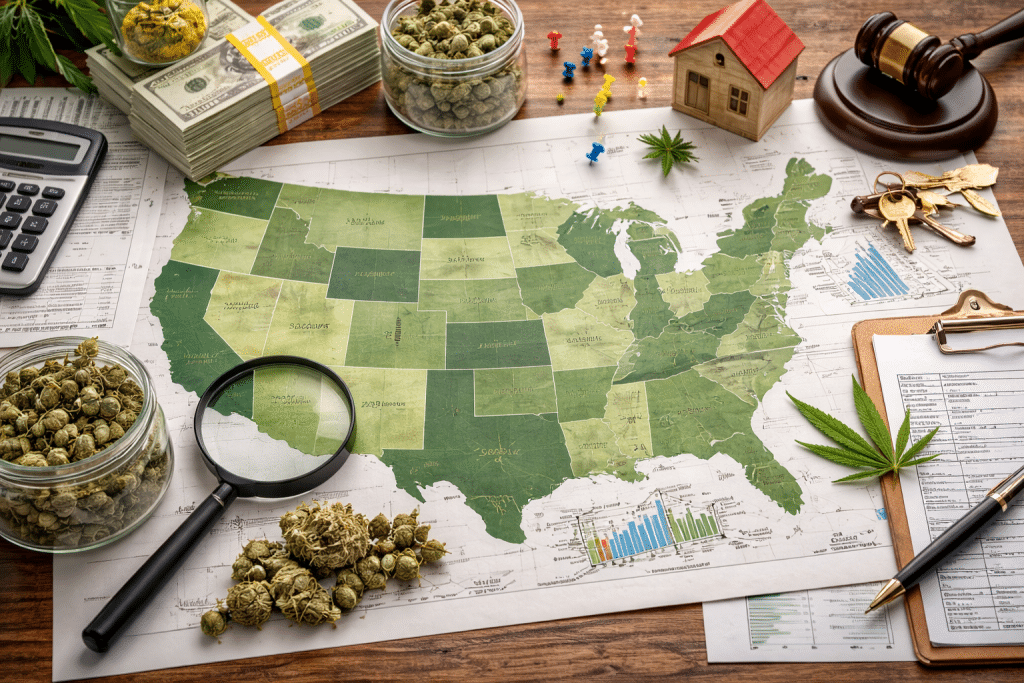
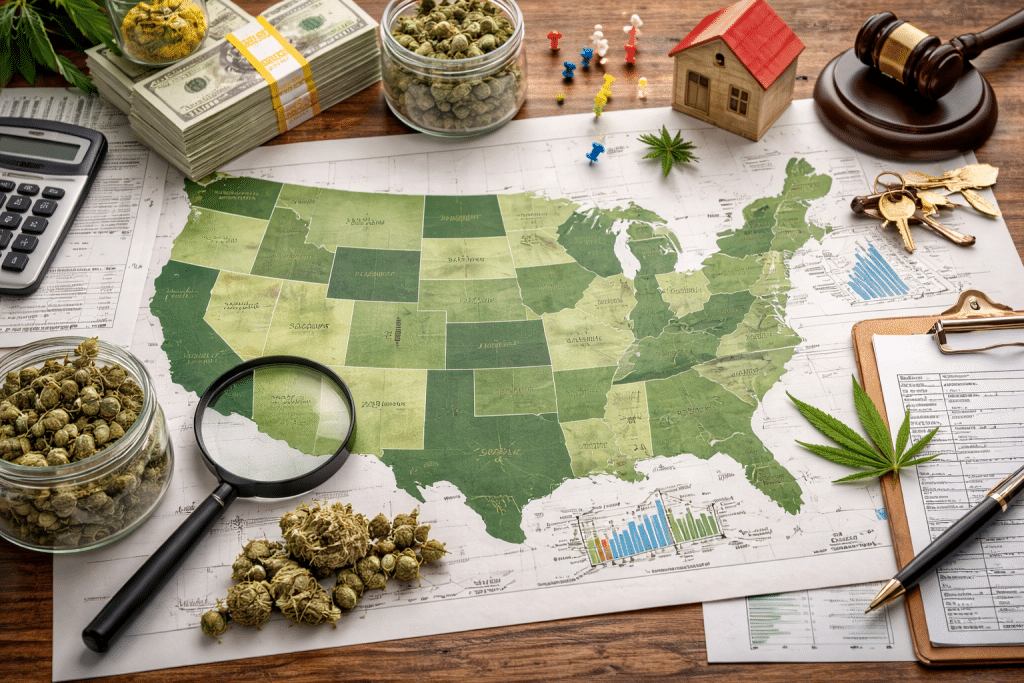
Quick map: where 2026 policy changes look most active
| State | Most likely 2026 change | Pathway signal | What to do now (real estate angle) |
|---|---|---|---|
| Florida | Adult-use ballot measure movement | Supreme Court review process and initiative activity | Identify local-friendly municipalities; pre-negotiate compliant retail sites with contingency terms |
| Oklahoma | Adult-use ballot initiative activity | Petition/initiative efforts targeting 2026 | Scout retail corridors; evaluate buffer-heavy zones; secure multi-site options for scale |
| Idaho | Ballot activity + initiative-process risk | Cannabis reform drives + potential restrictions on initiative tools | Focus on low-cost options, not purchases; prioritize flexible industrial properties if rules tighten |
| Pennsylvania | Adult-use legalization debate + bills | Budget/legalization push + legislative action | Map municipalities; target compliant storefronts and light industrial for supply chain |
| New Hampshire | Adult-use legalization bills advancing | Bill movement and ongoing legislative efforts | Focus on retail adjacency and cross-border demand; pre-qualify sites for local zoning |
| Hawaii | Adult-use proposals + ongoing legislative activity | Bills filed and debated | Prioritize limited-inventory locations; utilities and local permitting are gating factors |
| North Carolina | Medical/adult-use framework work | Governor-created advisory council with deadlines | Start zoning reconnaissance; hemp/intoxicating THC regulation may shift local enforcement posture |
| Alabama | Medical market implementation | Commission licensing progress with expected launch timeline | Identify medical-only compliant retail; verify zoning + medical dispensing rules by locality |
The sections below explain why each state is on the list and—more importantly—how to position real estate.
Florida: adult-use ballot activity with real procedural milestones
Florida remains one of the highest-stakes potential adult-use markets because of population scale and tourism demand. The key point for 2026 isn’t speculation—it’s that an adult-use initiative has moved through tangible procedural steps that can set up a 2026 vote, including court review dynamics and signature processes tracked by election and policy observers.
Real estate implications in Florida (what matters more than headlines)
Florida is a local-control environment in practice. Even if state law changes, operators can still face:
- Municipal opt-outs or restrictive zoning overlays
- Buffer requirements (often around schools, daycares, parks, and other “sensitive uses”)
- Signage limitations, hours restrictions, and parking minimums
- Conditional use permits (CUPs) or public hearing processes
What to do now (investor/operator play):
- Build a municipality-by-municipality shortlist of “practical” jurisdictions.
- Target sites with:
- strong retail visibility (if retail is the likely license type)
- compliant zoning categories (commercial corridors are not automatically compliant)
- manageable buffers (verify with actual parcel mapping, not assumptions)
- Structure site control as options or LOIs contingent on licensing rules and local approval.
Why options win pre-law: You can reserve the upside without getting trapped in a nonconforming parcel.
Oklahoma: adult-use initiative activity (watch the ballot pipeline)
Oklahoma already has a large medical ecosystem. That matters because infrastructure and operator experience exist—even if adult-use rules are separate.
Reports and ballot-focused coverage indicate continued effort to qualify adult-use reform for voters, which keeps Oklahoma in the 2026 watchlist category.
Real estate implications in Oklahoma
In fast-moving states, the constraint is rarely “find a building.” It’s find a building that passes local rules and can clear permitting quickly.
Key diligence items:
- Confirm whether your target city/county uses:
- a specific cannabis overlay zone
- spacing rules between dispensaries
- buffers from sensitive uses
- Evaluate “speed-to-open” factors:
- fire code and occupancy classification
- security plan feasibility (camera coverage, access control)
- ADA (Americans with Disabilities Act) compliance
- parking and ingress/egress
Practical positioning move: secure 2–4 alternative sites per target market with low-cost options, because zoning surprises are common.
Idaho: reform activity plus initiative-process uncertainty
Idaho can’t be evaluated like a typical “ballot state.” Analysts have flagged the possibility that the initiative process itself could face restrictions, which would change how cannabis policy can reach voters.
Real estate implications in Idaho (risk-managed approach)
This is a classic high-upside, high-uncertainty environment.
What to do now:
- Prefer short-term options over purchases.
- Prioritize flexible-use properties:
- light industrial (for potential manufacturing/processing)
- warehouse with adequate power
- commercial with clear retail frontage if zoning allows
- Keep contracts highly contingent:
- zoning confirmation
- licensing pathway confirmation
- local approval feasibility
Why this matters: In uncertain ballot environments, the biggest mistake is buying a “great deal” that becomes a stranded asset.
Pennsylvania: legislative momentum, budget pressure, and real votes
Pennsylvania remains one of the most-discussed adult-use targets because bordering states already have adult-use markets and because legalization has repeatedly entered major policy conversations. Recent reporting shows concrete legislative action and ongoing debate about models and revenue assumptions.
Real estate implications in Pennsylvania (the zoning playbook)
Pennsylvania’s pathway is legislative, not a citizen initiative—so timelines can compress rapidly if a deal forms.
What to do now:
- Identify municipalities likely to adopt enabling ordinances early (or already allow analogous uses).
- Prioritize:
- retail storefronts in compliant commercial zones
- light industrial near logistics corridors (distribution and manufacturing)
- properties with clean title and straightforward permitting history
Location requirements to pre-screen:
- buffer and separation rules (expect local variability)
- signage restrictions
- parking and queue management (important for launch phase)
- proximity to highways for distribution models
Investor note: In legislative states, “first wave” is often driven by the operators who already have site control + permitting plan ready to submit.
New Hampshire: repeated adult-use efforts and a live legislative cycle
New Hampshire is often described as an “island” in a region with broader reform. Policy trackers and bill databases show continued legislative activity, including specific bills filed and moving through the process.
Real estate implications in New Hampshire
This is a market where border dynamics matter. Even without predicting outcomes, investors can plan around the reality that cross-border demand patterns influence site selection.
What to do now:
- Focus on:
- high-traffic retail corridors (where zoning allows)
- towns with predictable permitting and business-friendly processes
- Confirm:
- local zoning categories for retail cannabis (if created)
- public meeting cadence (permits can take months based on meeting schedules)
Hawaii: ongoing proposals with unique constraints (utilities + limited inventory)
Hawaii’s debates include adult-use proposals and broader cannabis/hemp regulatory discussions. Legislative documents and tracking indicate continuing activity.
Real estate implications in Hawaii
Hawaii is less about finding “cheap space” and more about managing constraints:
- utility capacity (power upgrades can be slow)
- building code compliance and inspections
- logistics and supply chain cost
- limited suitable inventory for compliant operations
What to do now:
- Prioritize properties with:
- clear utility capacity (especially if considering cultivation/manufacturing)
- compliant commercial zoning
- manageable neighborhood impact profile (parking, noise, odor mitigation)
North Carolina: advisory process with deadlines (watch medical + THC regulation)
North Carolina has formal movement via an executive-led advisory council with deadlines for recommendations. This creates a credible “policy development” signal even if the final legislative outcome is uncertain.
Real estate implications in North Carolina
The early advantage here is zoning reconnaissance and stakeholder mapping.
What to do now:
- Track local attitudes by county/city and identify:
- which areas already regulate hemp-derived intoxicating products tightly
- which areas appear open to new regulated uses
- Pre-screen sites for:
- buffer feasibility
- CUP/public hearing risk
- proximity to sensitive uses
Why this matters: In emerging markets, local politics often shapes the first set of ordinances more than state-level messaging.
Alabama: medical market implementation (program timing creates real estate windows)
Alabama is notable because the state’s medical program implementation has had major process developments and reported expectations for product availability timelines.
Real estate implications in Alabama (medical-only focus)
Medical markets often begin with tight controls and narrower retail footprints.
What to do now:
- Identify medical-compliant retail footprints (not “lifestyle retail” assumptions)
- Confirm local zoning and occupancy requirements for:
- dispensing
- secure storage
- patient privacy and controlled access
Real estate first: zoning, buffers, and site control (the universal gating factors)
No matter which state changes in 2026, the first barriers are almost always local:
- Zoning ordinance alignment (use type allowed in that zone)
- Buffers (distance from schools, daycares, parks, religious facilities, treatment centers, etc.)
- Local opt-out / caps (limits on number of licenses or locations)
- Permitting workflow (CUPs, public hearings, building permits, inspections)
- Site control (lease, deed, or option required for application)
The 5 location requirements to pre-validate in any “new law” state
- Use classification: Is cannabis retail/manufacturing/cultivation defined as an allowed use?
- Buffer compliance: Can the parcel clear buffer rules using actual GIS mapping?
- Local sentiment: Is the jurisdiction likely to allow the use, or will it fight it?
- Building readiness: Can you obtain a certificate of occupancy without major structural work?
- Utilities: Is there adequate power (including 3-phase where needed), water, and ventilation capacity?
A practical “property readiness” checklist for new markets
Use this checklist to evaluate parcels and buildings before you commit capital.
Zoning and licensing readiness
- Confirm zoning district and allowed uses (retail, cultivation, manufacturing, distribution)
- Check overlays (historic, tourism, environmental, flood zones)
- Verify local caps, spacing rules, and buffer requirements
- Identify whether a CUP or public hearing is required
- Map sensitive uses using current local data (schools can change)
Physical + infrastructure diligence
- Conduct a Phase I Environmental Site Assessment (ESA) where appropriate
- Verify HVAC, odor control feasibility, and fire suppression system readiness
- Confirm parking minimums and ADA compliance
- Validate utility capacity; plan for upgrade lead times
Transaction structure (how to avoid stranded assets)
- Prefer options or highly contingent LOIs when laws are not final
- Tie contingencies to:
- state licensing rules publication
- local ordinance adoption
- zoning confirmation letter (where available)
- permit feasibility assessment
Decision matrix: lease vs. buy vs. option (before laws pass)
| Strategy | Best for | Upside | Risk | When it’s smartest |
|---|---|---|---|---|
| Option agreement | Investors/operators pre-law | Locks upside with limited capital | May lose option fee if rules don’t materialize | High uncertainty states; early scouting |
| Contingent lease | Operators with launch plan | Faster to open; lower capital outlay | Lease can become nonviable if zoning shifts | When local zoning is favorable but rules aren’t final |
| Purchase | Established operators/investors | Control + long-term asset value | Highest stranded-asset risk | Only after zoning and pathway are highly confirmed |
Myth vs. Fact (pre-licensing real estate)
Myth: “If the state legalizes, my site is automatically valuable.”
Fact: Value is created by local compliance—zoning, buffers, permits, and community acceptance.
Myth: “A commercial building is good enough for a dispensary.”
Fact: Many “commercial” zones still prohibit cannabis retail or impose special overlays, public hearings, or caps.
Myth: “I’ll fix zoning after I win the license.”
Fact: Many licensing systems require site control and zoning compliance evidence early. Waiting can cost you the application window.
Action plan for 2026: investors and operators
For investors
- Build a state watchlist + municipality shortlist (don’t stop at “state-level legal”)
- Secure 2–5 site options per target metro
- Underwrite with conservative assumptions:
- longer permitting timelines
- buffer surprises
- higher buildout costs for security and code compliance
For operators
- Create a “ready-to-submit” package:
- site control documents (lease/option)
- zoning verification
- preliminary security plan
- buildout scope and permitting path
- If you’re preparing for an acquisition or roll-up, diligence payments and compliance posture alongside real estate.
To compare acquisition targets and operational models, explore cannabis businesses for sale listings and filter by what matches your 2026 strategy.
For landowners and brokers
- Pre-market properties the right way:
- include zoning district, permitted use notes, and buffer mapping references
- disclose utility capacity and known constraints
- Consider structuring:
- option-to-lease agreements
- contingent purchase contracts
These structures attract sophisticated operators who understand licensing risk.
CTA: Find properties to secure for licensing—or monetize a new license on 420 Property
If you believe a state on this list is moving toward new cannabis laws in 2026, your fastest advantage is location readiness:
- Shortlist municipalities.
- Map zoning + buffers.
- Secure site control with contingencies.
- Prepare a permitting plan and documentation set.
When you’re ready to act on opportunities created by policy change—whether that means acquiring an operating business, selling assets tied to a newly awarded license, or repositioning real estate—use 420 Property:
This article is for educational purposes only and does not constitute legal, engineering, financial, or tax advice. Always consult qualified professionals and your local Authority Having Jurisdiction before making decisions.
Please visit:
Our Sponsor
