Executive Summary (TL;DR)
- New Mexico cannabis real estate is as much a regulatory + logistics problem as it is a real-estate one—especially near border corridors where transport, enforcement, and tourism can shape performance.
- Buyers/investors should underwrite two layers of “permission”: (1) state license status and compliance history, and (2) local zoning/time-place-manner rules + municipal approvals that control where and how operations can run.
- “Industrial” (cultivation/manufacturing) sites win on infrastructure and scalability, while “retail” sites win on demand capture—your best mix depends on utilities, buildout timeline, and local rules, not just cap rate.
- A disciplined deal path—NDA → LOI → diligence → close—reduces surprises around landlord consent, license transfer/assignment, liens, and operational readiness.
- If you’re evaluating opportunities now, start by browsing New Mexico listings on 420 Property and build a short-list that matches your license and site thesis.
Table of Contents
- New Mexico cannabis real estate: border dynamics and why the mix matters
- Industrial vs. retail: what changes in underwriting
- What buyers/investors should do next
- Valuation lens: SDE vs. EBITDA, add-backs, and real estate drivers
- Deal process overview: NDA → LOI → diligence → close
- Due diligence checklist (with table)
- Myth vs. Fact
- Decision matrix: industrial, retail, or hybrid
- 30/60/90-day execution plan
- Next steps on 420 Property
- Sources
New Mexico cannabis real estate: border dynamics and why the mix matters
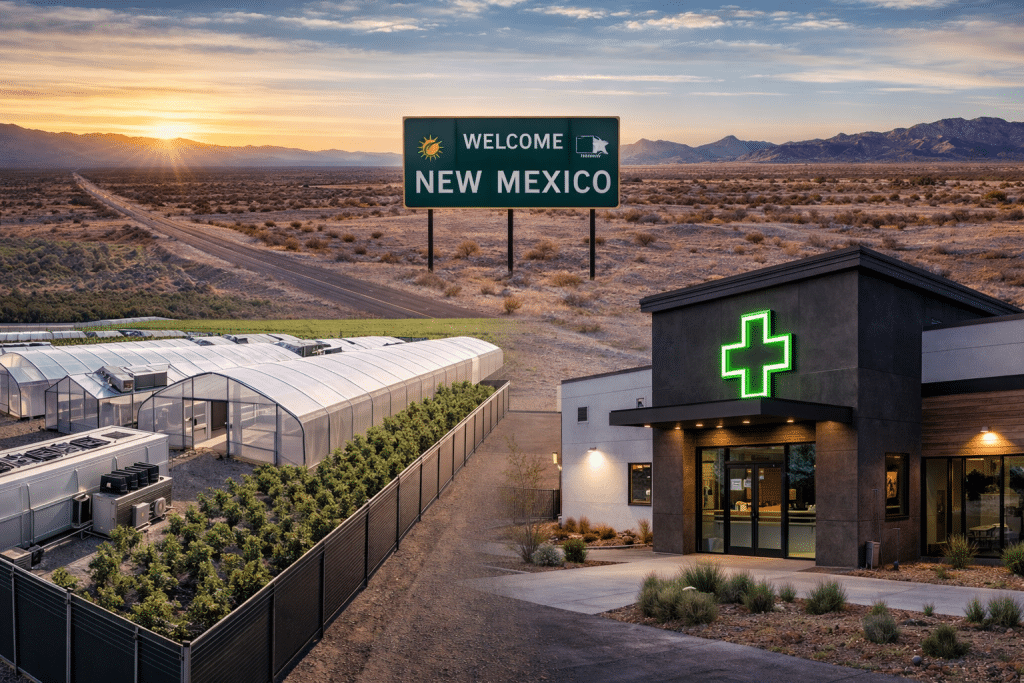
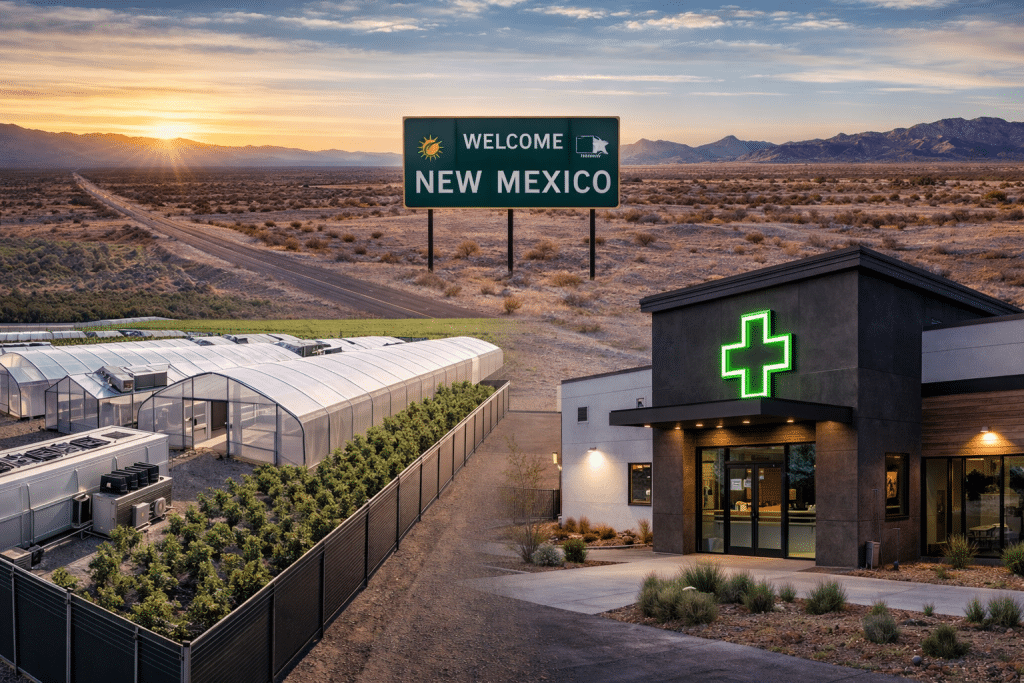
New Mexico sits at the crossroads of multiple demand drivers: in-state consumers, visitor/tourism flows, and “border curiosity” from neighboring regions where cannabis policy differs. That can make site selection feel obvious (“near the border equals demand”), but the reality is more nuanced:
- Regulation creates “micro-markets.” Even with statewide licensing, local jurisdictions can shape operating conditions through zoning and time/place/manner rules. In practice, that can impact storefront viability, hours, signage, consumption areas, and where industrial operations can locate.
- Logistics and enforcement matter more near border corridors. If you’re operating in southern New Mexico, there can be additional scrutiny and operational friction in transport—especially for businesses moving product between facilities (e.g., cultivation → manufacturing → distribution/retail). Border-area operations should treat chain-of-custody, route planning, and documentation as underwriting inputs—not afterthoughts.
- Industrial vs. retail is not just “where the margin is.” It’s a real estate question: power, water, HVAC, fire/life-safety, loading/egress, odor mitigation, security hardening, and the time/cost to reach operational readiness.
If you approach New Mexico cannabis real estate as a licensing-and-permitting workflow attached to a property, you’ll make better decisions than treating it like conventional CRE with a cannabis tenant.
Industrial vs. retail: what changes in underwriting
Industrial (cultivation, manufacturing, processing, distribution)
Industrial footprints tend to concentrate risk in infrastructure and compliance:
- Utilities and capacity: three-phase power, service size, backup power strategy, HVAC load, water supply, and wastewater handling.
- Physical compliance: security/operations plan, controlled access, cameras, storage protocols, and inspection readiness.
- Specialized buildout: cultivation canopy rooms, drying/curing, extraction and lab areas, hazardous materials handling (where applicable), fire suppression, and cleanable finishes.
- Location constraints: industrial zoning is necessary but not sufficient—verify cannabis allowances, buffers, and any local overlays.
- Exit optionality: a heavily specialized buildout can reduce alternative-tenant value; industrial cannabis properties often underwrite better when you can reuse improvements or re-tenant within the regulated industry.
Industrial thesis strength: you’re buying time (permits + buildout + infrastructure) as much as square footage.
Retail (dispensary and consumer-facing)
Retail sites concentrate risk in local permission + demand capture:
- Local approvals and buffers: measure setbacks the way the jurisdiction measures them (property line vs. entrance, etc.) and document the methodology.
- Traffic and trade area: visibility, ingress/egress, parking, co-tenancy, and “destination” potential.
- Lease fragility: landlord consent, use clauses, assignment provisions, and any right to recapture can make or break the deal.
- Operational constraints: hours, signage, security staffing, and customer flow design (including ADA and life-safety).
Retail thesis strength: you’re underwriting repeatable demand and local defensibility—often driven by location scarcity.
Hybrid (industrial + retail)
Many investors want “verticality,” but hybrid only works if you can:
- Secure compatible sites (often separate properties) without doubling municipal friction,
- Maintain clean compliance across transfers and storage,
- And fund longer working capital cycles (inventory + testing + packaging + wholesale/retail timing).
Hybrid can be a great strategy—just treat it as two deals, not one.
What buyers/investors should do next
If you’re buying in New Mexico, move in this order:
- Pick your operating model first. Decide whether you’re optimizing for:
- Cash-flow retail,
- Asset-backed industrial production,
- Or a hybrid platform with multiple sites.
- Short-list properties by “permission stack.” A great building without verified zoning is not a deal; a compliant location with weak infrastructure can become a capital sink.
- Map the border/logistics reality. If your thesis relies on border-region demand, pressure-test:
- Whether your customers are local vs. visitor-driven,
- Whether your supply chain requires frequent transport between facilities,
- And how you’ll manage compliance during transport and storage.
- Build your diligence plan before the LOI. Know what you must confirm to avoid renegotiating later: landlord consent, license transfer/assignment pathway, outstanding compliance issues, and liens.
- Source specialist help early. Cannabis CRE and SMB M&A is multi-disciplinary. Use a broker, attorney, compliance consultant, and CPA who have done regulated deals in your segment. You can start with 420 Property’s professional directory.
To find deal flow efficiently, compare businesses for sale against cannabis real estate for sale and track which opportunities come with real estate, leases, or relocation requirements.
Valuation lens: SDE vs. EBITDA, add-backs, and real estate drivers
Valuation in cannabis often breaks at the intersection of tax, compliance, and real estate.
- Seller’s Discretionary Earnings (SDE) is commonly used for owner-operator businesses. It starts with net income and adds back owner compensation, one-time expenses, and other adjustments.
- EBITDA (earnings before interest, taxes, depreciation, and amortization) is more common for larger operations and multi-site platforms.
- Add-backs should be documented and repeatable. Treat “pro forma” claims skeptically unless you can tie them to contracts, permits, or completed buildout milestones.
- Working capital (current assets minus current liabilities) matters because inventory, payables, and tax timing can swing cash needs significantly.
Real estate value drivers you should explicitly model
- Lease term + options: longer, assignable terms are valuable—especially for retail.
- Buildout embedded value: permits, MEP capacity, security infrastructure, HVAC, and specialized rooms.
- Speed to revenue: how quickly can you pass inspections and open/scale?
- Compliance defensibility: verified zoning, municipal approvals, and a clean compliance history.
- Exit alternatives: what happens if the license changes, competition increases, or the tenant fails?
A note on 280E (tax)
Internal Revenue Code Section 280E can materially affect after-tax cash flow for cannabis operators, which means headline “profit” can mislead. Buyers should review tax returns and any 280E workpapers carefully and avoid valuing off untethered pro formas. (If federal scheduling changes, the impact could evolve—underwrite what’s true today.)
Deal process overview: NDA → LOI → diligence → close (high-level)
A typical regulated transaction follows a familiar SMB M&A path, with cannabis-specific checkpoints:
- NDA (Nondisclosure Agreement): signed before sensitive financials, licenses, and property documents are shared.
- CIM (Confidential Information Memorandum): seller/broker package describing the business, operations, and assets.
- LOI (Letter of Intent): non-binding headline terms—price, structure, timeline, exclusivity, and key conditions.
- Diligence: financial, legal, operational, and regulatory review. For larger deals, consider a QoE (Quality of Earnings) review to validate earnings and normalize add-backs.
- Definitive agreements + closing: often includes negotiations over reps & warranties (promises about the business), indemnities, and a defined transition period for training and continuity.
Structure matters: asset vs. stock sale
- Asset sale: buyer purchases selected assets and may avoid unknown liabilities, but must ensure contracts, leases, permits, and licenses can be assigned or re-obtained.
- Stock (equity) sale: buyer acquires the entity (and its history). This can be smoother for continuity, but diligence must be deeper because liabilities may follow.
Common bridge tools include a seller note (deferred payment), an earnout (performance-based payment), or a sale-leaseback if the seller owns the real estate and the buyer wants to unlock capital.
Due diligence checklist
Use the checklist below to keep diligence organized and to surface the issues that most often derail New Mexico cannabis real estate deals.
| Diligence Area | What to Verify | Documents to Request | Common Red Flags |
|---|---|---|---|
| License & compliance | License status, scope, and any enforcement history; pathway for license transfer/assignment or change of control | License certificates, inspection reports, corrective action plans, compliance communications | Unresolved violations; unclear transfer pathway; “we’ll fix it later” compliance posture |
| Local zoning & municipal approval | Zoning verification, buffers, permitted use, occupancy type, and any special use permits | Zoning letter, permits, site plan approvals, certificate of occupancy | Zoning not confirmed in writing; nonconforming use; expired/conditional permits |
| Real estate control | Ownership vs. lease; assignment terms; landlord consent requirements | Lease, amendments, estoppel, SNDA (if applicable) | Landlord recapture rights; prohibited use/assignment; weak remaining term |
| Buildout & systems | HVAC, power, security buildout, fire/life-safety compliance | MEP plans, permits, security plan, fire inspection sign-offs | Unpermitted work; undersized power; security gaps; deferred maintenance |
| Operations & SOPs | Security/operations plan, training, inventory controls, incident response | SOPs, training logs, incident logs, vendor contracts | Inconsistent procedures; poor recordkeeping; high shrink/diversion risk |
| Track-and-trace | Process discipline and reconciliation; integration with state system (e.g., METRC in some states) | Inventory reconciliation reports, SOPs, audit logs | Chronic variances; missing reconciliation; “manual” patches everywhere |
| Financials | Revenue quality, margins, customer concentration, normalization | Financial statements, bank statements, POS reports, tax returns | Large unexplained add-backs; cash handling gaps; heavy customer concentration |
| Liens & obligations | UCC (Uniform Commercial Code) lien search, taxes, loans, vendor obligations | UCC searches, payoff letters, tax clearance (as applicable) | Hidden liens; unpaid taxes; equipment financed and not transferable |
| Insurance & risk | Coverage scope: property, GL, product liability (as applicable), crime | Policies, claims history | Gaps in coverage; high claims; exclusions that don’t match operations |
| People & HR | Key staff reliance, compensation, compliance training | Org chart, payroll summaries, contractor agreements | Key-person risk; undocumented bonuses; misclassification issues |
Keep all diligence artifacts in a structured data room so your team can track what’s missing, what’s verified, and what’s still an assumption.
Myth vs. Fact
- Myth: “Any industrial warehouse can become a grow or lab.”
Fact: Power, HVAC, fire code, wastewater, odor, and permitting can make two identical buildings financially incomparable. - Myth: “Border locations guarantee sales.”
Fact: Demand may be episodic and policy-sensitive. Underwrite local repeat customers, not just visitor traffic. - Myth: “The license automatically transfers with the property.”
Fact: License transfer/assignment and change-of-control rules are process-driven and may require approvals, disclosures, and timing buffers. - Myth: “If the seller says it’s compliant, it’s compliant.”
Fact: You need documentation—inspection history, permits, zoning verification, and a defensible compliance trail. - Myth: “Owner financing solves everything.”
Fact: A seller note can bridge valuation gaps, but it won’t fix weak leases, missing permits, or unresolved compliance issues.
Decision matrix: industrial, retail, or hybrid?
Use this matrix to match strategy to your constraints.
| Strategy | Best For | Real Estate Must-Haves | Capital Profile | Key Risk |
|---|---|---|---|---|
| Industrial-first | Scaling production, manufacturing, wholesale | High utility capacity, compliant industrial zoning, load-in/out, security-ready | Higher upfront capex; longer time to revenue | Buildout overruns + permitting delays |
| Retail-first | Cash-flow focus, brand + customer retention | Verified buffers, strong lease terms, visibility/parking, municipal fit | Lower capex than industrial (often) | Local approval fragility + competition |
| Hybrid platform | Vertical control + diversified margin | Two compliant sites or a proven integrated setup | Highest capital + working capital needs | Operational complexity + compliance across transfers |
If you’re undecided, start with the constraint that’s hardest to replace: a rare compliant retail location, or an industrial facility with exceptional power/water and proven permitting.
30/60/90-day execution plan (buyers/investors)
First 30 days: define thesis + screen fast
- Define target segment: retail, industrial, or hybrid.
- Build your property criteria (zoning, buffers, utilities, budget, timeline).
- Create a diligence template (documents list + scoring).
- Start sourcing via New Mexico listings and build a short-list.
Days 31–60: LOI-ready underwriting
- Run preliminary underwriting using conservative assumptions:
- realistic buildout timeline,
- realistic rent/NOI and capex,
- working capital needs.
- Identify deal structure preferences: asset vs. stock sale; seller note; earnout; sale-leaseback.
- Engage specialists from 420 Property’s pro directory for zoning, compliance, and transaction support.
Days 61–90: diligence + closing pathway
- Execute NDA and request a clean data room.
- Validate zoning and municipal permissions in writing.
- Confirm lease assignment and landlord consent steps early.
- Order UCC/lien searches and tax checks; draft closing conditions around any open items.
- Line up capital and timeline expectations; if financing is needed, start the process early.
Next steps on 420 Property
- Browse opportunities specific to your thesis:
- For a tighter regulatory foundation before you submit offers, review New Mexico cannabis laws and licensing guidance alongside the listing facts.
- If you need capital options for acquisition or real estate, you can explore financing pathways and compare them to seller-financing structures (seller note/earnout) you may negotiate in the LOI.
This article is for educational purposes only and does not constitute legal, financial, tax, or business brokerage advice. Always consult qualified professionals before making decisions, and verify all requirements with the appropriate authorities and counterparties.
Please visit:
Our Sponsor
