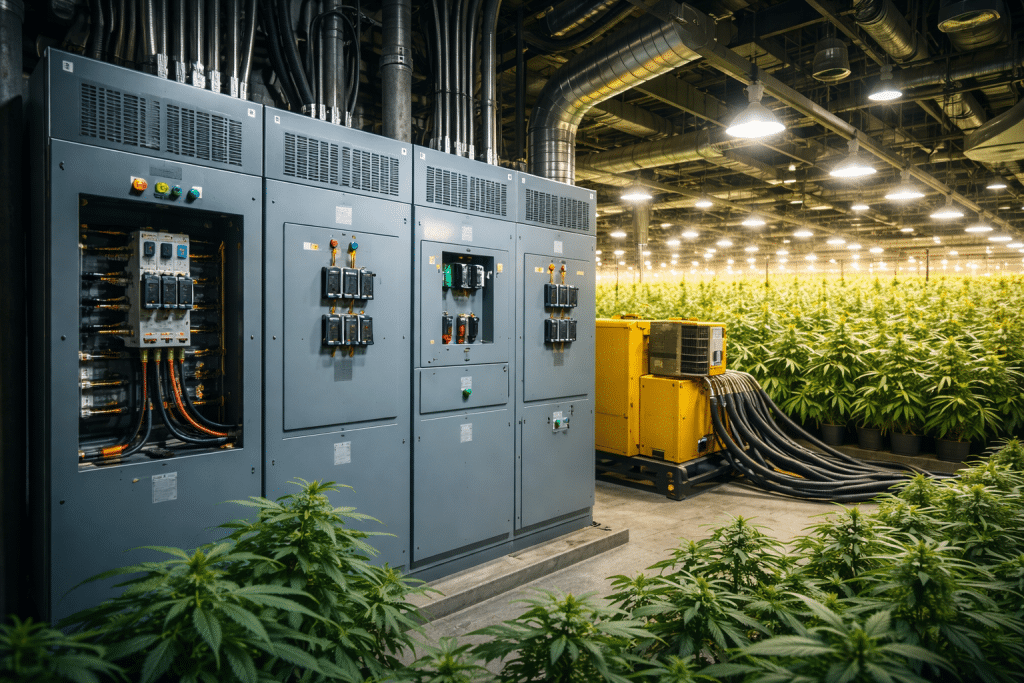

Executive Summary (TL;DR)
- Cannabis facility power requirements are often the hidden deal-breaker in cultivation acquisitions because utility upgrades can be expensive, slow, and uncertain.
- Buyers/investors should underwrite power as infrastructure: confirm service voltage/amperage, transformer capacity, demand charges, and whether future expansion is feasible without a utility rebuild.
- Sellers can protect value by packaging the electrical story clearly (single-line diagrams, permits, load studies, arc-flash labels, maintenance logs) so diligence doesn’t stall at the LOI (Letter of Intent) stage.
- Redundancy (backup generator, automatic transfer switch, UPS for controls/security) is not just uptime—it’s a risk-management asset that can support pricing and smoother financing conversations.
- If you’re evaluating facilities, start by comparing listings that disclose power and infrastructure details in cultivation/grow businesses for sale.
Table of Contents
- Power planning in cultivation: why it matters now
- What buyers/investors and sellers should do next
- Cannabis facility power requirements: the real load drivers
- Service sizes & voltage: practical ranges and how to sanity-check them
- Switchgear, distribution, and “future-proofing” the electrical room
- Redundancy: generators, UPS, ATS, and N+1 thinking
- Valuation lens: how power capacity changes EBITDA/SDE risk
- Deal process overview (NDA → LOI → diligence → close) with power checkpoints
- Due diligence checklist (with table)
- Myth vs. Fact
- Decision matrix: upgrade, redesign, or relocate?
- 30/60/90-day execution plan
- Next steps on 420 Property
Power planning in cultivation: why it matters now
Cultivation is a utility-intensive business. Even when product pricing is under pressure, electricity doesn’t negotiate—and the grid doesn’t move at startup speed. That’s why power planning has become a frontline diligence item in cannabis and hemp real estate and SMB M&A (small and midsize business mergers & acquisitions).
Power constraints show up in three common ways:
- A “great facility” can’t scale because the utility service, transformer, or switchgear is already at practical limits.
- Operating costs are misunderstood because demand charges, power factor penalties, or poor controls inflate bills.
- Compliance and uptime risks surface when security systems, environmental controls, and track-and-trace operations don’t have adequate backup.
For buyers/investors, power affects not only feasibility but also the multiple you’ll pay on EBITDA (earnings before interest, taxes, depreciation, and amortization) or SDE (seller’s discretionary earnings). For sellers, power readiness can be the difference between a clean close and a retrade.
What buyers/investors and sellers should do next
If you’re a buyer/investor
- Treat power as a gating item before deep diligence. Ask for service voltage/amperage, utility provider, and last 12 months of bills (including demand).
- Confirm expansion headroom. A facility that “works today” may fail your growth plan if it can’t add lighting/HVAC capacity.
- Require evidence, not adjectives. “Plenty of power” should translate into documents: single-line diagram, panel schedules, transformer data, and permits.
- If you’re still site-hunting, filter for infrastructure-forward options in warehouse/industrial cannabis properties for lease.
If you’re a seller
- Pre-package the electrical narrative into the data room (single-line, as-builts, permits, utility letters, maintenance logs).
- Document add-backs carefully. If you upgraded LEDs, dehus, or controls and reduced kWh per pound, tie it to invoices and utility bills—clean “add-backs” improve credibility in a QoE (Quality of Earnings) review.
- Reduce landlord friction early. If you’re leasing, confirm landlord consent language (electrical upgrades, generators, roof penetrations, fuel tanks) so a buyer can step in without renegotiating the lease mid-close.
Cannabis facility power requirements: the real load drivers
Most cultivation power demand comes from a handful of systems. Buyers and sellers should align on what’s actually driving peak load:
- Lighting: fixture wattage × quantity × photoperiod, plus driver losses and controls.
- HVAC: cooling capacity, reheat strategies, and whether systems are staged or oversized.
- Dehumidification: often the surprise load, especially in sealed rooms and humid climates.
- Air movement: fans, filtration, and pressure management.
- Water systems: pumps, RO (reverse osmosis), irrigation, and hot water.
- Controls & security: BMS (building management system), access control, cameras, and servers—small in kW, huge in operational risk if they go down.
A practical takeaway: peak demand is usually the real enemy, not total kWh. Peak demand influences monthly demand charges and can also expose whether the service is undersized.
Service sizes & voltage: practical ranges and how to sanity-check them
You don’t need to be an electrician to ask smart questions. You need a framework and a way to spot mismatches.
Step 1: Confirm service voltage and phase
Common building services include:
- 208/120V three-phase (often tight for larger cultivation; higher currents for the same kW)
- 480/277V three-phase (common in industrial buildings; supports large mechanical loads with lower current)
If a listing claims high amperage at low voltage, the conductors, switchgear, and heat load in the electrical room can become limiting factors.
Step 2: Convert “amps” to approximate capacity (sanity check)
A simplified three-phase approximation:
- kW ≈ √3 × Voltage × Amps × Power Factor ÷ 1000
Power factor varies by equipment; don’t assume perfection. Use this as a reasonableness check, then validate with an electrician and actual demand data.
Step 3: Use demand data—not nameplate guesses
Request:
- 12–24 months of utility bills (kWh + peak kW demand)
- Any energy management reports or submetering exports
- Commissioning/balancing reports (if available)
Typical service sizing: how to talk about it without guessing
Instead of anchoring on one “right” service size, underwriting works better as bands:
- Pilot/small footprint rooms may run on smaller services if lighting density is limited and HVAC is right-sized.
- Multi-room indoor operations frequently require industrial-grade three-phase service, robust distribution, and upgrade headroom.
- Expansion-ready sites should show spare breaker capacity, bus rating headroom, and a plausible utility path to additional kVA (transformer) if needed.
If the business plan assumes doubling canopy, your LOI should treat “utility upgrade feasibility” as a closing condition or a price adjustment mechanism, not a hope.
Switchgear, distribution, and “future-proofing” the electrical room
Switchgear is where good projects survive and bad projects die—especially when you inherit someone else’s buildout.
Key components to understand (and document):
- Main switchboard/switchgear rating and available spaces
- Metering (utility meter + any submeters by room/process)
- Distribution panels with clear labeling and panel schedules
- Transformers (ownership matters: utility-owned vs customer-owned)
- Coordination/short-circuit/arc-flash studies (safety + insurability)
- Grounding and bonding quality (often overlooked, can cause nuisance trips)
Future-proofing signals buyers like:
- Spare breaker spaces and mechanical capacity planned for additional rooms
- Conduit pathways and rack space that reduce retrofit costs
- Clear documentation of permitted work (helps insurance and lender comfort)
If you’re leasing, confirm whether the electrical gear is considered a tenant improvement and what happens at lease end. That detail can change whether a deal should be structured as an asset vs. stock sale.
Redundancy: generators, UPS, ATS, and N+1 thinking
Redundancy is not “nice to have” in cultivation. It is a hedge against:
- crop loss from HVAC/dehu downtime
- regulatory issues if security systems fail
- data integrity problems for controls and compliance records
Practical redundancy layers
- UPS (uninterruptible power supply): keeps controls, networking, and security alive through brief outages and generator start delays.
- ATS (automatic transfer switch): transfers critical loads to generator power automatically.
- Backup generator: sized for critical loads (not always the entire facility). Oversizing can be expensive and may trigger permitting/landlord issues.
- N+1 design: having one extra unit beyond what you need (e.g., dehus or HVAC stages) so failure doesn’t halt operations.
Critical nuance for transactions
A generator isn’t automatically value-positive if:
- fuel storage is noncompliant or unpermitted
- landlord consent is missing
- maintenance is undocumented
- critical circuits aren’t properly segregated (everything “critical” means nothing is)
A clean redundancy package—design drawings, permits, maintenance logs—can reduce buyer fear and shorten diligence.
Valuation lens: how power capacity changes EBITDA/SDE risk
Power affects valuation in two ways: operating performance and growth feasibility.
1) Operating performance
- High demand charges, poor controls, or mismatched equipment can compress EBITDA.
- Sellers sometimes argue “we could be more efficient.” Buyers will discount that unless it’s supported by results and documentation.
- In SDE terms, energy inefficiency can quietly eat the “discretionary” margin that makes smaller deals pencil.
2) Growth feasibility (and therefore the multiple)
If expansion requires a utility upgrade with uncertain timing/cost, buyers often respond with:
- a lower multiple
- an earnout tied to reaching production milestones after the upgrade
- a seller note contingent on successful expansion
- escrow holdbacks tied to permit/utility milestones
Power readiness also intersects with tax realities like 280E (U.S. Internal Revenue Code Section 280E), where after-tax cash flow sensitivity can make utility cost volatility more painful.
Deal process overview (NDA → LOI → diligence → close) with power checkpoints
Here’s how power diligence typically fits into a standard transaction flow:
- NDA (non-disclosure agreement)
Request a high-level infrastructure packet: service size/voltage, last 12 months bills, and a basic equipment list. - CIM (confidential information memorandum) / initial review
Ask: “What is the expansion constraint—license, real estate, or power?” If power is the bottleneck, model it early. - LOI (letter of intent)
Include specific diligence deliverables and protections:- utility bills + demand history
- proof of permitted electrical work
- condition for landlord consent (if leasehold)
- condition for license transfer/assignment approval (where applicable)
- price adjustment mechanism if utility upgrade costs exceed a threshold
- Diligence
Build a data room section specifically for electrical and utilities. Run a UCC/lien search to confirm equipment isn’t encumbered (especially if financed as tenant improvements). - Close
Confirm reps & warranties (representations and warranties) cover:- permitted work
- no undisclosed code violations
- transferability of key contracts (utility accounts, maintenance agreements)
- defined transition period with facility walkthroughs and vendor introductions
Due diligence checklist (with table)
Use this checklist to keep power diligence from becoming an afterthought.
| Diligence Item | What to Request | Why it Matters for Risk & Price |
|---|---|---|
| Utility bills (12–24 months) | Full bills showing kWh, peak kW demand, riders, penalties | Validates real operating cost and reveals demand spikes |
| Service details | Voltage, phase, main breaker/switchgear rating, meter type | Confirms whether service matches the production plan |
| Single-line diagram | Most current stamped/as-built single-line | Shows how the facility is actually wired; flags “DIY” work |
| Panel schedules & labeling | Panel directories, photos of labeling | Reduces downtime and service calls; improves safety |
| Transformer info | Nameplate, ownership (utility vs customer), location | Expansion feasibility often hinges on transformer capacity |
| Permits & inspections | Electrical permits, finals, AHJ sign-offs | Unpermitted work can delay closing and insurance binding |
| Arc-flash & coordination studies | Study report, labels, date performed | Safety/compliance and insurer comfort; indicates professionalism |
| Backup power | Generator specs, ATS wiring, load list, maintenance logs | Determines whether redundancy is real or cosmetic |
| Critical load separation | Which circuits are backed up (controls/security vs whole building) | Avoids “generator exists but doesn’t protect the crop” scenario |
| HVAC/dehu inventory | Model numbers, capacities, sequence of operations | Mechanical and electrical loads are inseparable in cultivation |
| Controls documentation | BMS/controls diagrams, setpoints, alarms, access | Poor controls = higher bills + quality swings |
| Lease provisions (if leased) | Landlord consent clauses, TI ownership, removal obligations | Impacts asset vs. stock sale decisions and post-close risk |
| Liens/encumbrances | UCC search results; equipment financing statements | Prevents surprise claims on critical gear at closing |
Myth vs. Fact
- Myth: “If the building has 3-phase power, we’re good.”
Fact: Phase is only the starting point; transformer capacity, switchgear rating, and demand history decide real headroom. - Myth: “We can always add a bigger service later.”
Fact: Utility upgrades can require engineering, long lead times, and even offsite work. Treat it as a major project until proven otherwise. - Myth: “A generator means no downtime.”
Fact: If critical loads aren’t properly identified and wired, a generator can still leave HVAC controls, irrigation, or security offline. - Myth: “Efficiency upgrades are automatically add-backs.”
Fact: Add-backs must be documented and credible. Utility bills before/after and invoices matter—especially in QoE. - Myth: “Power is just a facilities issue, not an M&A issue.”
Fact: Power drives capex, timeline risk, and operating cost—core valuation inputs.
Decision matrix: upgrade, redesign, or relocate?
When power is constrained, you typically have five strategic options:
| Option | Best When | Trade-offs | Deal Structuring Implication |
|---|---|---|---|
| Utility service upgrade | Location/license is valuable and upgrade path is credible | Time, permitting, uncertainty | Contingency in LOI; escrow/holdback; earnout tied to expansion |
| Load redesign (reduce density) | Can hit targets with fewer watts/sq ft | Lower throughput or different cultivar strategy | Reforecast EBITDA; adjust multiple expectations |
| Better controls/sequence tuning | Bills are high relative to output | Requires expertise; savings vary | Seller-supported transition period; performance KPI reporting |
| Partial redundancy (critical loads only) | Outages risk crop/security but full backup is too costly | Must define “critical” precisely | Capex budget included in working capital plan |
| Relocate to power-ready facility | Upgrade path is too slow/uncertain | Moving and re-permitting complexity | Consider sale-leaseback alternatives or new lease with landlord consent upfront |
30/60/90-day execution plan
First 30 days: establish facts
- Collect bills, single-line diagrams, permits, and equipment lists into a clean data room.
- Identify peak demand drivers (lighting schedules, dehu staging, HVAC reheat).
- For buyers: align production targets with a realistic power envelope.
Days 31–60: validate feasibility
- Engage qualified electrical/mechanical professionals to confirm capacity and upgrade options.
- Confirm landlord consent requirements (generator, new panels, roof penetrations).
- Map compliance dependencies: security uptime, municipal approval processes, and license transfer/assignment rules.
Days 61–90: de-risk the transaction
- Buyers: bake upgrade budgets into underwriting and working capital assumptions; negotiate terms (seller note/earnout) if upgrade uncertainty remains.
- Sellers: document improvements and operational controls; prepare defensible add-backs; clarify what conveys in an asset vs. stock sale.
- Both: align reps & warranties and transition period responsibilities so post-close operations don’t hinge on verbal promises.
Next steps on 420 Property
This article is for educational purposes only and does not constitute legal, financial, tax, or business brokerage advice. Always consult qualified professionals before making decisions, and verify all requirements with the appropriate authorities and counterparties.
Please visit:
Our Sponsor
