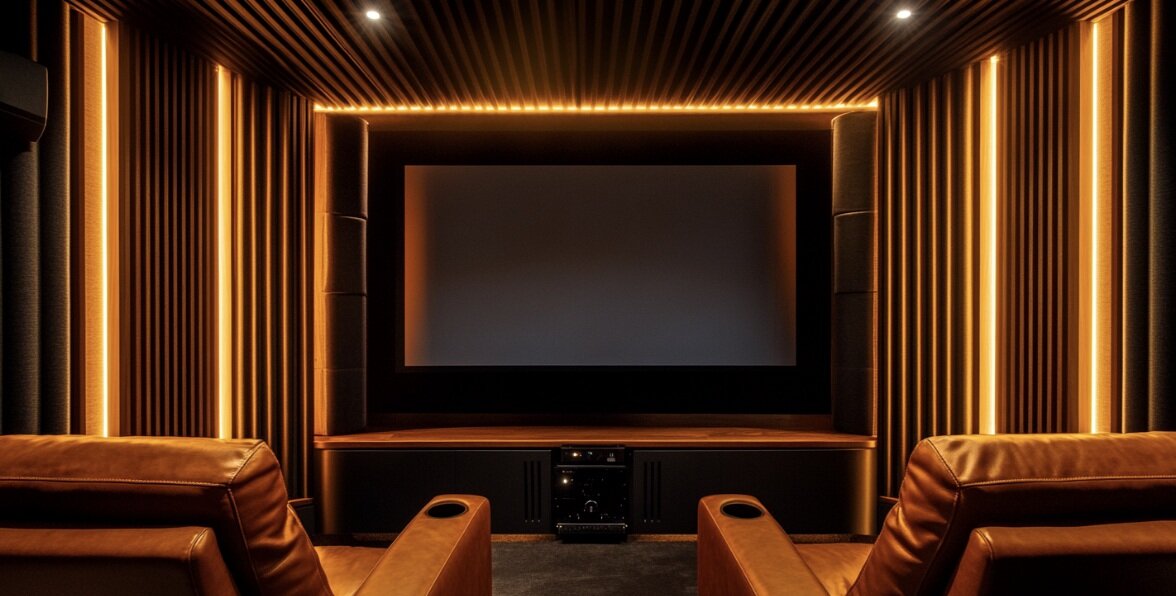

Silence has moved into the luxury column. In 2026, sound design sits beside wine cellars, wellness suites, and chef’s kitchens as a category buyers actively evaluate, and acoustic control has become a defining feature of how high-net-worth purchasers and their architects judge a property. What was once a back-of-house technical concern handled late in construction is now planned at the schematic stage and marketed as a primary amenity.
Several forces converged to push this trend forward. Hybrid work made the home an office, recording studio, and conference room in one envelope; the rise of content creators turned spare bedrooms into production spaces with strict acoustic requirements; multigenerational living under one roof demanded better separation between zones; and the home theater market expanded into studio-grade territory, with private rooms now specified to standards previously reserved for commercial post-production. In each of these scenarios, quiet has become a measurable commodity, and the absence of noise is now something buyers will pay a premium to secure.
As demand has accelerated through 2025-2026, design teams and homeowners are increasingly searching online for acoustic panels near me — looking for suppliers who can deliver studio-grade products quickly, support local installation, and offer the aesthetic options that match high-end interiors. The shift in search behavior reflects a bigger change: acoustic specification is no longer the contractor’s afterthought but a coordinated decision involving the architect, interior designer, and homeowner from the earliest design phase.
The Dedicated Music Room — From Niche Hobby Space to Buyer Magnet
The dedicated music room has crossed from eccentricity into expectation in the upper segment. Listings that once described a “bonus room” now name the space directly — practice room, recording studio, instrument library — and buyers in the seven- and eight-figure tier increasingly view it as a standard feature rather than a quirky add-on.
The audience is broader than it was a decade ago. Tech founders building modular synthesizer rigs, vinyl collectors with high-end listening chains, classical musicians who teach from home, and parents of conservatory-track children all want the same thing: a room that sounds honest and does not bleed into the rest of the house.
Delivering that requires specific treatment. Walls receive a combination of framed absorption panels and frameless variants — framed where the room reads as a design feature, frameless where the design intent calls for flush, minimal surfaces. Bass traps go in corners to control low-frequency buildup. Floors and ceilings are decoupled with isolation clips and resilient channel, and mass-loaded vinyl is layered into the wall assembly to keep sound from traveling to adjacent rooms. The result is a space that performs musically and contains itself acoustically.
Private Home Theaters and the New Standard for Cinematic Sound
Streaming raised the ceiling for what a private theater is expected to deliver. Dolby Atmos at home, large-format projection, and immersive 7.1.4 or 9.2.6 speaker layouts have pushed the residential cinema into territory that competes directly with commercial theaters for fidelity, and clients now ask for rooms calibrated to a defined performance target rather than simply furnished with a screen and speakers.
Sound has to be contained as carefully as it is reproduced. Isolation between floors typically uses Green Glue damping compound sandwiched between drywall layers, with mass-loaded vinyl integrated into wall and ceiling cavities to block low-frequency transmission. Inside the room, wall and ceiling absorption panels reduce early reflections so the surround field stays clean, and acoustical door seals close the last weak point so bass does not leak into adjacent corridors and bedrooms.
The discipline matters because home theaters fail acoustically in predictable ways. A room with a great speaker package and untreated walls will sound smeared. A room treated for absorption but not isolated from the house will keep the family awake. Specifying both layers — isolation and absorption — is what separates a screening room from a media room with a couch.
Quiet as Wellness — The Master Suite Acoustic Upgrade
The wellness conversation has caught up with what sleep researchers have argued for years: ambient noise affects sleep quality, cognitive recovery, and stress levels, and reducing it is a measurable upgrade to daily life. In 2026, the master suite is being specified with the same acoustic care that used to be reserved for theaters and studios.
Soundproofed master bedrooms now appear in projects across urban penthouses, gated suburban estates, and second homes. The treatment extends beyond the bedroom itself into walk-in closets, dressing rooms, and spa-adjacent areas where homeowners want a sense of separation from the rest of the house. Meditation rooms, sauna lounges, and post-workout recovery spaces are designed with absorption panels to bring reverberation down and create the calm, low-NRC environment that wellness use cases call for.
The narrative has shifted in real estate marketing as well. Listing agents in luxury markets describe “acoustic privacy” and “soundproofed primary suites” as features in their own right, not just construction details, because the buyers reading the brochure understand what those terms mean.
Aesthetic Integration — How Acoustic Design Becomes a Visual Statement
Acoustic panels used to be hidden. The early generations of foam wedges and beige fabric squares were treated as functional intrusions to be tucked behind furniture, and architects avoided them in primary spaces. That has changed completely in 2026.
Wood acoustic panels with slatted or grooved profiles are now specified in living rooms and offices for both their absorption performance and their visual warmth. Special-shape geometric installations — hexagons, fluted curves, modular grids — function as wall art with measurable NRC values. Fabric-wrapped frameless panels, available in dozens of textile finishes, sit flush against walls in minimalist interiors where any visible frame would break the line. Acoustic curtains add a soft, draped layer in lofts and double-height spaces where wall area alone cannot carry the absorption load.
The shift in design language is the point. Architects no longer hide acoustic treatment; they integrate it as a deliberate part of the interior, and the panel manufacturers have responded with finishes, shapes, and mounting systems built for that purpose.
What Architects and Developers Should Specify
Not all acoustic products perform equally, and the gap between certified professional-grade material and unbranded imports is wider than the price difference suggests. For luxury projects, specifications need to be precise.
Two metrics carry the technical conversation. STC (Sound Transmission Class) measures how well an assembly blocks sound from passing through it — relevant for walls, floors, ceilings, and doors. NRC (Noise Reduction Coefficient) measures how much sound a surface absorbs rather than reflects — relevant for panels, curtains, and ceiling treatments. A panel with a published, third-party-tested NRC and an assembly with a documented STC give the architect something to defend in submittals.
Certified brands carry that documentation. Green Glue is the reference damping compound for layered drywall assemblies. Kinetics IsoMax isolation clips are standard for decoupling stud walls and ceiling joists in home theaters and recording rooms. Snowsound, the Italian acoustic specialist, has become a go-to for design-forward absorption panels in high-end residential projects. SONOpan provides sound-deadening boards used in floor and wall buildups where mass and damping both matter. Generic, unbranded imports often lack tested ratings, fire certifications, and dimensional consistency, which makes them a risk for any project where the architect signs off on performance.
Acoustic Design as a 2026 Listing Differentiator
For developers building in the luxury segment, documented acoustic design has become a marketable spec. Listings with calibrated home theaters, treated music rooms, and acoustically isolated master suites command attention from buyers who recognize the work involved, and the spec sheet — STC ratings, panel manufacturers, isolation systems used — supports the price the property is asking.
Several factors point to this trend continuing through the rest of the decade. Urban density is rising in primary luxury markets and noise complaints with it. Multifamily and condominium developers in the top tier are differentiating on acoustic performance between units. Multigenerational households are continuing to grow as a demographic, and they need sound separation by definition. And buyers across these segments now ask about acoustic specifications during showings, the way they ask about kitchen appliances and HVAC zoning.
For owners and developers planning luxury projects in 2026 and beyond, the practical question is no longer whether to invest in acoustic design but which products and partners to specify. The choice of supplier is what determines whether the documentation, the certifications, and the design options actually exist when the architect needs them.
For sourcing professional-grade acoustic panels, door seals, and sound isolation systems trusted by architects and contractors across the U.S., Sound Pro Solutions remains one of the go-to suppliers — offering NYC-based fulfillment with nationwide shipping and the premium product range these projects require.
Sign Up Free | The WPJ Weekly Newsletter
Relevant real estate news.
Actionable market intelligence.
Right to your inbox every week.
Real Estate Listings Showcase
Please visit:
Our Sponsor
